
Just 45 kilometers north of Amman, the ancient city of Jerash offers one of Jordan’s most remarkable journeys into the past. Often described as one of the best-preserved Roman provincial cities in the world, Jerash—known in antiquity as Gerasa—reveals an extraordinary blend of Roman, Greek, Byzantine and early Islamic heritage.
With its monumental columns, temples, theaters, plazas and ancient streets, Jerash is a destination where history is not simply displayed—it is experienced on foot. A visit can easily be combined with a trip to Ajloun, the northern Jordan Valley or other attractions in northern Jordan.
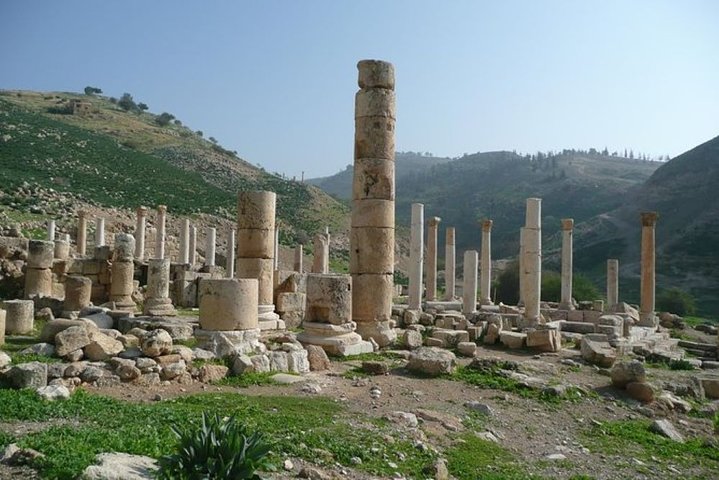
What to See and Do in Jerash
Walk Along the Cardo Maximus
One of the highlights of any visit is the Cardo Maximus, the approximately 800-meter-long colonnaded street that formed the architectural spine of ancient Gerasa. Visitors can still see the original paving stones and traces of ancient chariot traffic, offering a fascinating glimpse into everyday life in the Roman city.
Walking along the Cardo is particularly rewarding in the morning, when the light highlights the towering columns and the surrounding archaeological remains.
Explore the Oval Plaza
The spectacular Oval Plaza is one of Jerash’s most recognizable landmarks. Surrounded by Ionic columns, the expansive plaza connected the Cardo with the Sanctuary of Zeus and served as an important public space in ancient Gerasa.
It is also one of the best places in the archaeological site to appreciate the scale and sophistication of Roman urban planning.
Discover the Temples of Zeus and Artemis
Jerash was home to important religious sanctuaries, including the imposing Temple of Zeus and the monumental Temple of Artemis. Their surviving columns and architectural remains demonstrate the importance of religion in the ancient city.
The Temple of Artemis, in particular, occupies a prominent position overlooking the ancient city and provides excellent opportunities for photography.
Visit the Ancient Theaters
Jerash has two major theaters. The South Theater is particularly impressive for its size and acoustics, while the North Theater was expanded in the 3rd century AD and could accommodate around 1,600 people.
Standing in the center of the theater and imagining ancient audiences gathering for performances and civic events is one of the most memorable experiences in Jerash.
See the Nymphaeum and Cathedral
The beautifully preserved Nymphaeum, an ornamental Roman fountain constructed in 191 AD, is another essential stop. Its elaborate design once included marble decoration and water flowing through carved lion heads.
Nearby, the remains of the Cathedral demonstrate how the city changed over the centuries as Christianity became an important part of Jerash's cultural landscape.
Admire Hadrian’s Arch and the Hippodrome
Begin or end your archaeological tour at Hadrian’s Arch, constructed to commemorate Emperor Hadrian’s visit to Jerash in 129 AD. Beyond it lies the ancient Hippodrome, where chariot races and other spectacles once entertained crowds of thousands.
Today, the Hippodrome can also host the Roman Army and Chariot Experience (RACE), which recreates elements of Roman military life, gladiatorial combat and chariot racing.
Experience Jerash Beyond the Ruins
A visit to Jerash does not have to end at the archaeological site. The surrounding region offers opportunities to experience local food, rural landscapes, nature and community-based tourism. The official Jerash tourism platform highlights local food, trails, nature experiences and community attractions alongside the archaeological heritage.
Travelers can also explore the countryside around Jerash, enjoy traditional Jordanian cuisine and continue north toward the green landscapes of Ajloun and Dibeen.
For a cultural experience, consider visiting during the Jerash Festival for Culture and Arts, when the ancient city becomes a spectacular setting for music, dance, theater, poetry and other performances. The festival traditionally takes place during the summer, with events staged among the archaeological monuments.
Best Time to Visit Jerash
The best time to visit Jerash is generally spring and autumn, particularly from March to May and September to November. Temperatures are usually more comfortable for walking around the extensive archaeological site, while spring brings green landscapes and wildflowers to northern Jordan.
Spring is especially attractive for travelers who want to combine Jerash with Ajloun and the surrounding forests, while autumn offers pleasant conditions for exploring the ruins without the strongest summer heat.
Summer can still be an excellent time to visit, particularly if you want to experience the Jerash Festival, but temperatures can be high during the middle of the day. An early-morning visit is therefore recommended.
Winter offers cooler temperatures and occasional rain, but it can provide a quieter archaeological experience. Visitors should check opening times before traveling, as the official Jerash tourism information lists different hours for winter and summer.
How to Get to Jerash
Jerash is an easy day trip from Amman. The journey by road takes around 40 minutes, depending on traffic, making it one of the most accessible major archaeological attractions in northern Jordan.
For first-time visitors, starting at the Jerash Visitors Center is recommended. The center provides maps, information about the archaeological site and tourist routes, and access to local guides who can help bring the history of ancient Gerasa to life.
Tips for Visiting Jerash
Wear comfortable walking shoes because exploring the archaeological city involves considerable walking over ancient stone surfaces. Bring water, sun protection and a hat, particularly during the warmer months.
Allow at least two to three hours for the main archaeological site, and longer if you want to explore at a relaxed pace, take photographs or join a guided tour.
Most importantly, don't rush. Take time to look beyond the famous columns and imagine Jerash as a living city—with markets, religious sanctuaries, theaters, public squares and busy streets.
Why Jerash Should Be on Your Jordan Itinerary
For travelers interested in history, architecture and culture, Jerash is one of Jordan’s essential destinations. Its extraordinary preservation allows visitors to walk through an ancient Roman city while discovering layers of history that continued through the Byzantine and Islamic periods.
Combined with its proximity to Amman, beautiful northern landscapes and vibrant cultural traditions, Jerash makes an ideal day trip from Amman and an essential stop on a wider Jordan itinerary.
Whether you visit to admire Roman architecture, explore ancient streets, attend a cultural festival or simply experience one of Jordan’s most impressive archaeological landscapes, Jerash offers a journey through more than two millennia of history.